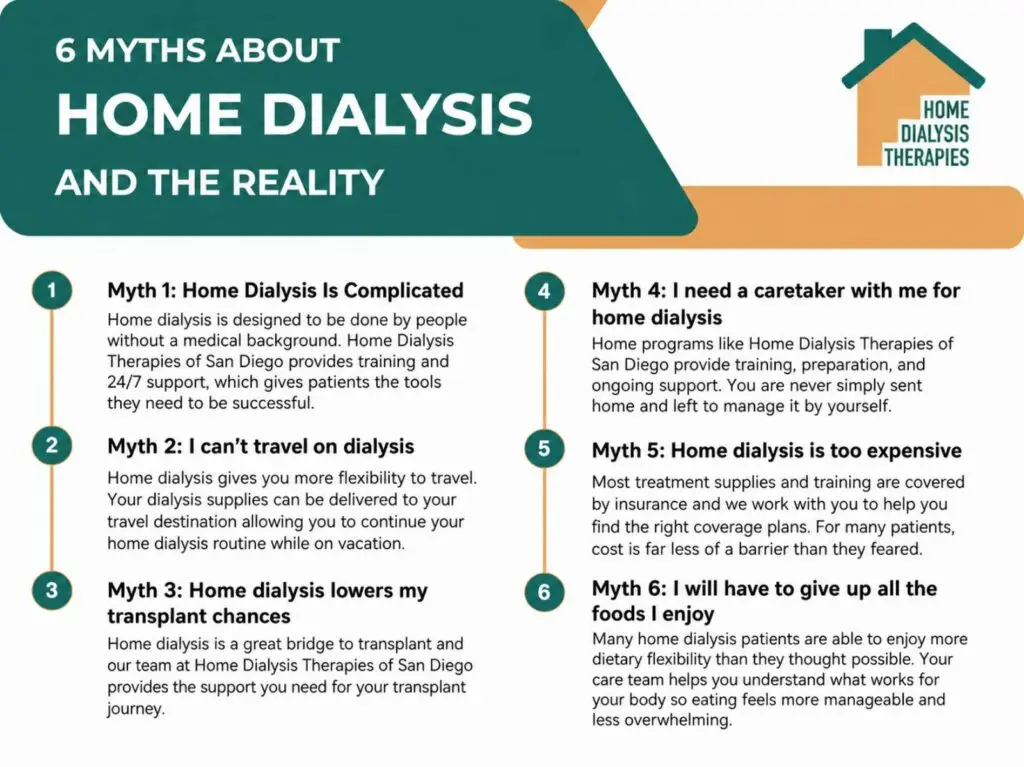
Myth 1: Home Dialysis is Too Complicated
You may have been led to assume home dialysis is only realistic for someone with a medical background. It can sound like too many steps, too much responsibility, and too much pressure to handle at home.
However, home dialysis programs at clinics like Home Dialysis Therapies of San Diego are designed to teach you how treatment works, how to perform it safely, and make you and your caretaker feel confident doing it at home. You are trained step by step by experienced nephrology nurses. You can ask any questions. You can learn the routine at a pace that builds familiarity over time, and you can quickly gain the confidence which comes from guidance and repetition.
For many people, the biggest barrier is the fear of the unknown. Once the process is explained clearly and broken down into practical steps, it often feels much more manageable than expected. Published research points in the same direction. A 2020 systematic review and meta-analysis found that home dialysis patients had better physical health-related quality-of-life scores than in-center hemodialysis patients.
In our free options education program, one of our trained nurses will walk you through all your dialysis treatment options, answer your questions, walk you through what the training will look like, and give you all the resources so you can move forward with clarity and confidence.
Myth 2: Home Dialysis Means You Can’t Travel
One of the most common myths when it comes to dialysis is that once it becomes part of your life, travel is effectively over. It can sound like you would be stuck at home, unable to visit family, take a trip, or make plans that extend beyond your normal routine.
For many home dialysis patients, travel is still very much on the table. It just takes some advance planning. At Home Dialysis Therapies of San Diego, your care team can help you think through where you are going, how long you will be away, what supplies you will need, and what needs to happen before you leave. Federal guidance explains that peritoneal dialysis can be done while traveling and that supplies can often be shipped to your destination ahead of time, which makes the process far more manageable than many people first assume.
A lot of the fear comes from not knowing what is actually possible. Once the logistics are explained clearly and broken down into practical steps, travel can start to feel realistic and manageable again.
Myth 3: Home Dialysis Lowers Your Transplant Chances
There is a prevailing myth that home dialysis somehow makes you a weaker transplant candidate. It can sound like once you choose one path, you close the door on the other.
Home dialysis can still fit within a much bigger plan for your health and your future. If transplant is one of your goals, treatment at home can support your stability and quality of life while that goal remains in view. At Home Dialysis Therapies of San Diego, transplant support is a major part of the care model, and published research points in the same direction. A 2022 systematic review and meta-analysis in JAMA Network Open found no significant difference in all-cause mortality or death-censored graft failure between pre-transplant peritoneal dialysis and hemodialysis, and it found a lower risk of delayed graft function with pre-transplant peritoneal dialysis.
What often holds people back is the fear that one treatment choice will quietly sabotage the future they are hoping for. Once the facts are explained clearly, home dialysis can be understood as part of a larger plan that still keeps transplant in view.
Myth 4: You Must Have a Care Partner With You To Do Home Dialysis
It is a common misconception that home dialysis only works if someone is with you at all times. It can sound like independence disappears and that treatment at home is only realistic if a family member is always available beside you.
The answer depends on the type of home dialysis you do, your medical needs, and what your care team believes is safest for you. National Kidney Foundation guidance explains that care partner needs can vary, and some people can handle more of their care independently. Others may need more support, especially depending on the modality. The important thing is that your situation should be evaluated clearly and personally.
For many people, the biggest barrier is assuming every form of home dialysis requires the same level of support. Once the details are explained clearly, the picture usually becomes much less intimidating. You can learn what applies to your situation, what kind of help may be useful, and what level of independence may still be possible.
Myth 5: Home Dialysis is Too Expensive
Some patients are led to believe that home dialysis is financially unrealistic. It can sound like the equipment, supplies, and training would create costs that you and your family simply could not absorb.
In reality, the financial picture is often far more manageable than you may expect once the details are explained clearly. Medicare states that Part B covers home dialysis training, home dialysis equipment and supplies, certain home support services, and dialysis-related drugs and services for people with Original Medicare who qualify. At Home Dialysis Therapies of San Diego, we also help patients and families understand Medicare, Medi-Cal, employer insurance, and secondary coverage so you are not left trying to decode everything alone.
What usually makes this feel overwhelming is the fear of a financial burden that has never been translated into actual numbers. Once the coverage framework is explained and your specific situation is reviewed in context, the question becomes far more manageable. You deserve specifics before assumption makes the decision for you.
If you want to understand what home dialysis may look like financially in your specific case, our social workers will help work with you one-on-one so you can learn more about coverage, timing, and the questions worth asking next.
Myth 6: Home Dialysis Means You Will Have to Give Up All the Foods You Enjoy
You may assume that home dialysis means a future built around constant restriction and think that meals will become stressful, food become joyless, and every bite will feel like something you have to fear. However, the reality is often more encouraging than you might expect!
Your diet still needs to be guided by your labs, treatment type, fluid needs, and overall health, though that does not automatically mean every meal becomes a source of stress. Because home dialysis often involves more frequent treatment, some patients experience greater dietary flexibility than with in-center dialysis. At Home Dialysis Therapies of San Diego, our registered dietitians help you understand what to eat, give personalized dietary guidance, and dispel the fear that dialysis means giving up every food you enjoy.
We have found that, once the facts are explained clearly, the dietary restrictions that come with dialysis become much more manageable. Many patients find they can still enjoy much of what they love!
If you want to understand what eating on home dialysis may actually look like for you, we have put together some helpful resources so you can learn more about building a plan that supports your health and gives you more dietary freedom.
Want To Learn More About Home Dialysis?
If you want a better picture of how home dialysis works, what your treatment options may look like, and how it can fit into everyday life, we have provided a guide that will walk you through the ins and outs of home dialysis, the basics of treatment, the main home dialysis options, and the factors that can help you and your care team decide what fits your life best.