

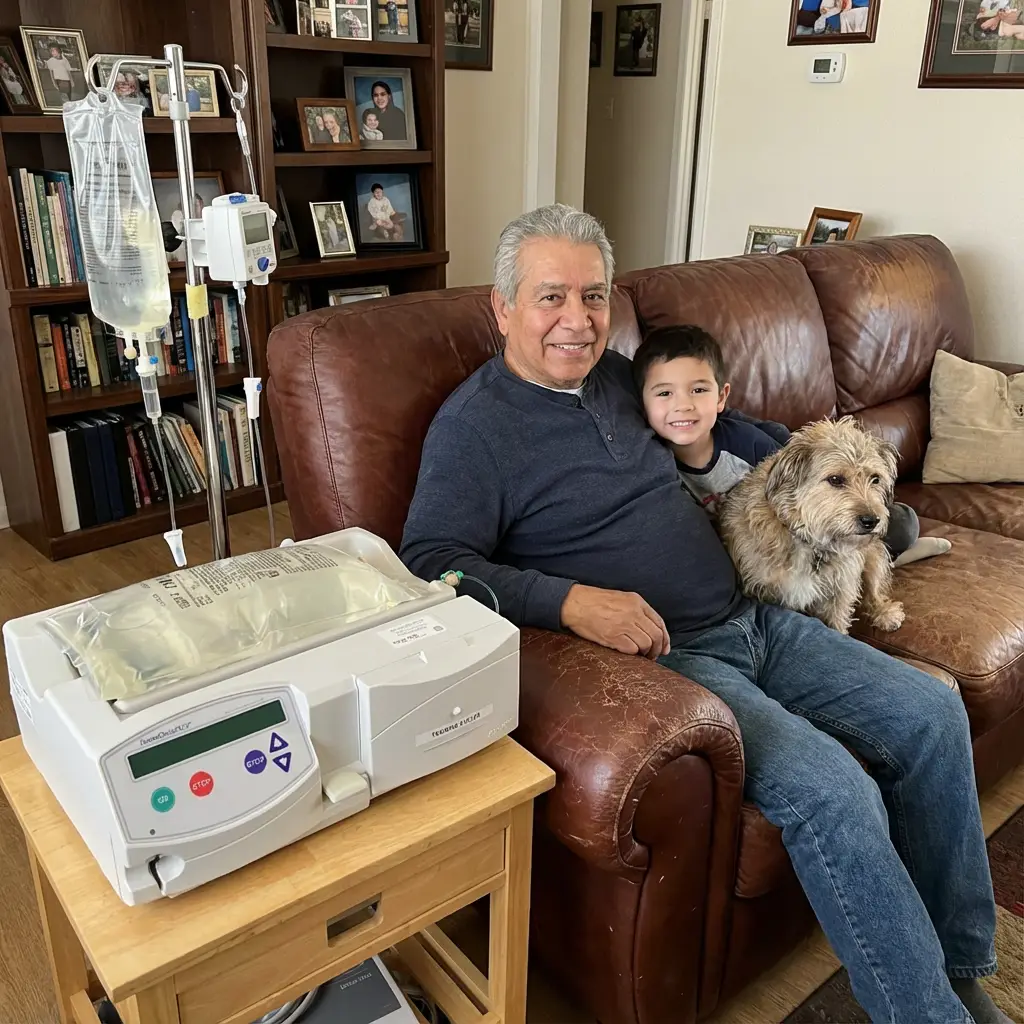
Some home dialysis options require a care partner, while others can sometimes be done independently. Many HHD programs expect a partner who can help with machine setup, needle placement, and emergency procedures. PD can sometimes be done alone if you can safely handle the equipment and follow instructions, though some patients use assisted PD if they need help. Your team at HDT will review what is required for each therapy, look at your support network, and talk through realistic ways to share responsibilities.
Frequently Asked Questions
What is the difference between peritoneal dialysis and home hemodialysis?
Peritoneal dialysis (PD) uses the lining of your abdomen as a filter. Fluid goes in and out of your belly through a soft catheter, either with a machine at night (APD) or by manual daytime exchanges (CAPD). Home hemodialysis (HHD) uses a compact machine and your bloodstream, similar to in-center dialysis, but treatments are usually shorter and more frequent. Some people prefer PD because it does not involve needles; others prefer HHD because it feels closer to what they already know from in-center care. At HDT, you can learn about both options in detail and decide which fits your health, home, and daily routine best.
Is home dialysis as safe as in-center dialysis?
For many patients, home dialysis is at least as safe as in-center dialysis when it is set up and monitored correctly. In some studies, people on well-supported home therapies have had better blood pressure control, fewer large fluid shifts, and more stable symptoms. Safety depends on good training, clean technique, reliable equipment, and regular follow-up with your care team. Your nurse and nephrologist will review your medical history, home situation, and support system to decide whether PD or HHD is a reasonable option for you.
Will my insurance or Medicare cover home dialysis?
In the United States, Medicare and most commercial insurance plans cover home dialysis, including PD and HHD, when it is ordered by your nephrologist. The structure of copays, deductibles, and supply coverage can vary by plan, so it is important to talk with your social worker or insurance case manager before you switch. They can help you understand how training, equipment, home modifications, and medications are billed, and what your likely out-of-pocket costs will be compared with in-center care.
Can I travel while on home dialysis?
Many patients on home therapies are able to travel, but the planning looks different for PD and HHD. PD patients often travel with supplies shipped ahead or packed in checked luggage, and may arrange space in hotels or family homes for exchanges. HHD travel may involve coordinating with a partner clinic or using in-center treatments at your destination. HDT provides travel planning guidance, checklists, and support for prescriptions and supply shipments so you are not trying to organize everything alone. If you are thinking about a trip, start that conversation early with your care team.
How do I know if home dialysis is right for me?
Choosing home dialysis is a personal decision that depends on your health, your living space, and what you want your life to look like on treatment. Home therapies may be worth exploring if you want more control over your schedule, would value shorter recovery times after treatments, or prefer care in a familiar environment. They may be less suitable if you have severe medical or mobility issues that make it hard to manage equipment safely, or if your living situation is very unstable. The best way to decide is to combine a thorough options education visit, an honest talk with your nephrologist, and a practical look at your home and support system.
